Few skincare ingredients have become as familiar as hyaluronic acid. It’s in serums, moisturisers, masks, mists, even makeup. And yet it’s often misunderstood, starting with its name.
First, it isn’t that kind of acid
When people hear acid in skincare, they tend to think of exfoliants: glycolic, salicylic, lactic. Hyaluronic acid is something else entirely.
It doesn’t exfoliate, it doesn’t tingle, and it doesn’t make your skin more sensitive to the sun. The word acid simply comes from its chemistry. In practice, it’s one of the gentlest ingredients in skincare, suitable for almost every skin type, including sensitive skin.
What it actually is
Hyaluronic acid occurs naturally in the body, including in the skin, where it helps keep skin cushioned and hydrated. It’s a humectant, which means it attracts water and holds on to it.
You’ll often read that it can hold up to a thousand times its weight in water. That figure is worth taking loosely, but the principle stands: it’s a very effective way of drawing moisture into the skin’s surface, which is why skin looks plumper and smoother almost straight away.
How it works on your skin
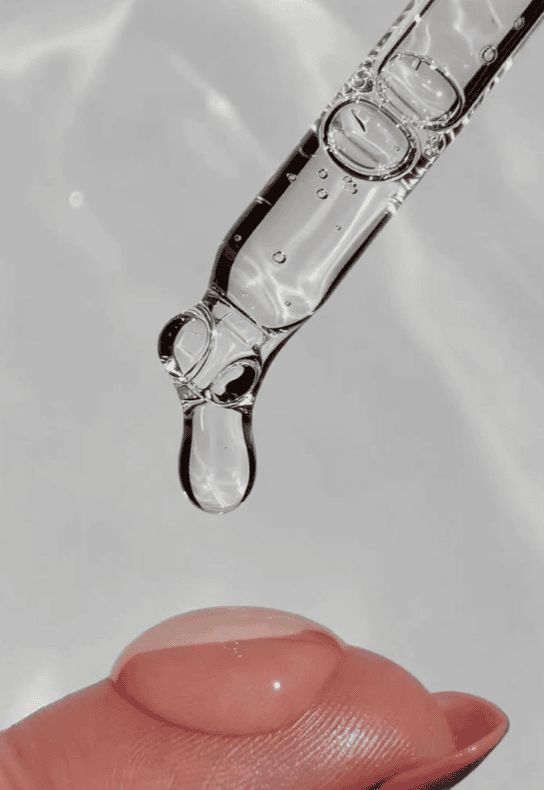
As a humectant, hyaluronic acid pulls water from wherever it can find it. On damp skin, it draws in that moisture and holds it at the surface.
There’s one catch. In very dry conditions, like a heated London flat in winter or a long-haul flight, it can draw water from the deeper layers of your skin instead, which can leave skin feeling tighter. That’s why how you apply it matters:
Apply it to damp skin, so it has water to hold on to.
Follow with a moisturiser, to seal that hydration in.
The different types
Not all hyaluronic acid is the same. The main difference is the size of the molecule.
High molecular weight hyaluronic acid is larger, and sits on the surface of the skin. It forms a light, hydrating film that gives that immediate smooth, plump look.
Low molecular weight hyaluronic acid is smaller, and can reach slightly further into the skin’s upper layers.
Sodium hyaluronate is the salt form of hyaluronic acid. It’s smaller and more stable, which is why it’s one of the most common forms you’ll see on ingredient lists.
Many formulas now combine several molecular weights, so they can hydrate at different levels at once. If you see multi-weight on a label, that’s what it means.
Why it became a skincare obsession
Partly because the results are so visible. Within minutes, skin looks dewier and feels softer, and that’s very satisfying.
Partly because it’s so easy to use. It suits almost everyone, works morning or night, and layers well with most other ingredients, including vitamin C, vitamin A and exfoliants.
And partly because the skin’s own levels decline with age, which gives it a natural place in conversations about ageing.
It’s worth being clear on what it does and doesn’t do, though. Hyaluronic acid hydrates. It can make fine lines look softer while the skin is plumped with water, but it doesn’t change the skin’s structure the way vitamin A can. Its effects are also temporary, which is why it works best as a consistent, everyday step.
The short version:
Hyaluronic acid draws water into the skin and holds it there. It hydrates; it doesn’t exfoliate.
Ask yourself:
Is my skin dehydrated, tight, or looking less plump than usual? That’s where it helps most.
Worth knowing:
Always apply it to damp skin and seal it with moisturiser, especially in dry weather.