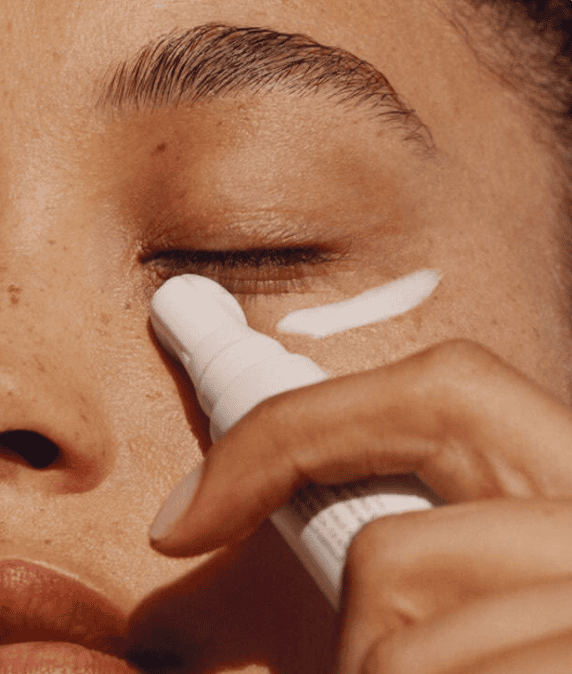
Eye cream is one of the most debated steps in skincare. Some people swear by theirs. Others are convinced it’s just a very small pot of moisturiser at a very large price.
The truth sits somewhere in between. You don’t need an eye cream. But the eye area is different from the rest of your face, and a product made for it can do a job your face moisturiser sometimes can’t.
Why the eye area is different
The skin around your eyes is among the thinnest on the body. It has fewer oil glands than the rest of your face, and it moves constantly, every time you blink, smile or squint.
That combination is why the eye area often shows dryness, fine lines and crepiness first. It also makes it more delicate and more easily irritated, particularly by products that drift into the eyes.
What makes an eye cream different
Many eye creams share ingredients with face moisturisers. The difference is how they’re formulated.
Eye products are usually designed and tested to be gentle on this area. They tend to use lower concentrations of active ingredients, are often fragrance-free, and have textures designed to stay put rather than travel into your eyes.
The simplest way to think about it: an eye cream is a moisturiser made specifically for the eye area.
Do you need one?
Not necessarily. If your face moisturiser is gentle, fragrance-free and doesn’t irritate your eyes, it can be used around the eye area too.
An eye cream is worth considering if:
Your face products sting or make your eyes water.
You use vitamin A or exfoliating acids on your face, which are best kept away from the delicate eye area.
You have a specific concern around the eyes that you’d like to target.
Matching the ingredient to the concern
Like serums, eye products are built around different ingredients for different concerns.
Dryness and fine lines: hyaluronic acid, ceramides and peptides help hydrate and smooth. Gentle retinol eye creams are designed for fine lines, and are formulated to suit this delicate area.
Puffiness: caffeine can temporarily reduce puffiness, and cooling applicators help too. Puffiness is often influenced by sleep, salt and fluid retention, so results from any cream are usually short-lived.
Dark circles: the right ingredient depends on the cause. If they’re caused by pigmentation, vitamin C and niacinamide can help. If they’re caused by thin skin showing the blood vessels underneath, vitamin A can help strengthen the skin over time. If they’re caused by the natural structure of your face, like hollows that create shadow, no cream can change that. That’s a job for concealer.
Crepiness and loss of firmness: retinol and peptides are the most useful.
Cream, serum or gel
Gels and serums are lighter, absorb quickly and sit well under makeup. They’re ideal in the morning, and for puffiness.
Creams and balms are richer and more nourishing. They’re best at night, and for drier skin.
Some people use a lighter product in the morning and a richer one at night.
How to apply it
Apply your eye product after serums and before moisturiser. That way, you can apply your moisturiser to the rest of your face, working around the eye area rather than over it.
Use a tiny amount: about a grain of rice per eye.
Apply around the orbital bone, the bone that circles your eye, rather than right up to the lash line. The product will naturally travel a little.
Use your ring finger, which naturally applies the lightest pressure, and gently tap rather than rub.
Keep strong face products away, like vitamin A and exfoliating acids, unless the product is made for the eye area.
And don’t forget sunscreen. The eye area is often missed, and it’s where UV damage shows early. A gentle, eye-safe sunscreen and good sunglasses both help.
The short version:
An eye cream is a moisturiser made for the eye area. Useful for some, not essential for all.
Ask yourself:
Do my face products irritate my eyes? Is there a specific concern I want to target?
Worth knowing:
No eye cream can fix dark circles caused by the shape of your face. That’s a job for concealer.