“Get a trim, it’ll help it grow.”
Most of us have heard it, usually from a hairdresser, a mother or a friend with enviably long hair. And it makes intuitive sense. Cutting a plant encourages it to grow, so why wouldn’t hair work the same way?
The short answer is that it doesn’t. Trimming your hair doesn’t make it grow faster. But there’s a good reason the myth has lasted so long, and it’s worth understanding, because it changes how you look after your hair.
Where hair actually grows
Hair grows from the follicle, a tiny structure beneath the surface of your scalp. That’s where new cells are made, pushing the hair upwards and outwards. It’s the only part of the hair that’s alive.
Everything you can see and touch, the strand itself, is made of keratin, a protein. Once it grows out of the scalp, it has no nerves, no blood supply and no living cells. That’s why cutting your hair doesn’t hurt.
It’s also why cutting your ends can’t affect how fast it grows. There’s no connection between the ends of your hair and the follicle. No signal travels back down the strand to tell the follicle it’s been trimmed. Whether you cut a centimetre off or leave it untouched, your follicles carry on at exactly the same pace.
On average, hair grows about one to one and a half centimetres a month, and that rate is largely set by your genetics.
So why does trimming seem to help?
Because what we usually mean by “growing” our hair is really keeping our length.
When the ends of your hair are damaged, they start to split. A split end doesn’t stay at the tip. It can travel further up the strand, and eventually the hair breaks. So while your hair is growing at the root, you’re also losing length at the ends.
Regular trims remove split ends before they travel and cause breakage. Your hair keeps more of the length it grows, so over time it genuinely does end up longer. Not because it grew faster, but because less of it broke off.
Freshly trimmed hair also looks fuller and healthier. Blunt, even ends look thicker than thin, frayed ones, which adds to the impression that a trim has worked some kind of magic.
The shaving myth
The same misunderstanding sits behind another famous myth: that shaving makes hair grow back thicker, darker or faster.
It doesn’t, and studies going back to the 1920s have shown that shaving doesn’t change how thick hair grows or how quickly. Shaving cuts the hair at the surface, and it can’t reach the follicle any more than a trim can.
What shaving does change is how the hair feels and looks as it grows back. A hair naturally tapers to a fine point. Shaving cuts it straight across, leaving a blunt tip, so regrowth feels coarser. New hair also hasn’t yet been lightened by the sun, so it can look darker as it first appears. Both effects are real, but they’re about the shape of the tip, not the hair itself.
What actually affects hair growth
Some things genuinely do influence how your hair grows:
Genetics sets your growth rate, and how long each hair grows before it naturally sheds. This is why some people’s hair seems to stop at a certain length.
Age, as hair growth tends to slow over time.
Nutrition, as deficiencies in things like iron or protein can affect hair.
Hormones, which influence both growth and shedding.
Stress and illness, which can cause temporary increases in shedding.
If you notice sudden or significant shedding, it’s worth speaking to a GP, dermatologist or trichologist, as there’s often an underlying cause.
So how often should you trim?
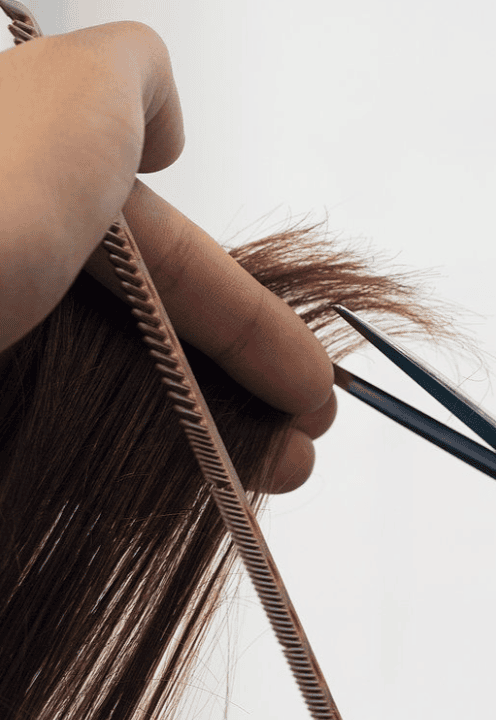
If you’re growing your hair, a trim every 8 to 12 weeks is a good rhythm for most people. Ask for a dusting, a very small trim that removes just the split ends, so you keep as much length as possible.
The less damage your ends take, the less you need to cut off. Healthy ends are only part of growing longer hair, though. For everything else that genuinely helps, from everyday habits to when it’s worth seeing a specialist, read How to grow your hair longer: what actually works.
The short version:
Trimming doesn’t make hair grow faster. It helps you keep the length you grow, by stopping split ends from causing breakage.
Ask yourself:
Is my hair not growing, or is it breaking? Split, frayed ends are usually the sign it’s breaking.
Worth knowing:
Shaving doesn’t make hair grow back thicker or faster either. The regrowth only feels coarser because the tip is cut blunt.