Have you ever fallen for a fragrance at the counter, only to find it smells completely different by lunchtime? It’s not your imagination. Fragrances are built to change as you wear them.
Every fragrance is made in layers, and each layer shows itself at a different time. Once you understand how that works, it becomes much easier to choose a scent you’ll still love at the end of the day.
What the fragrance pyramid is
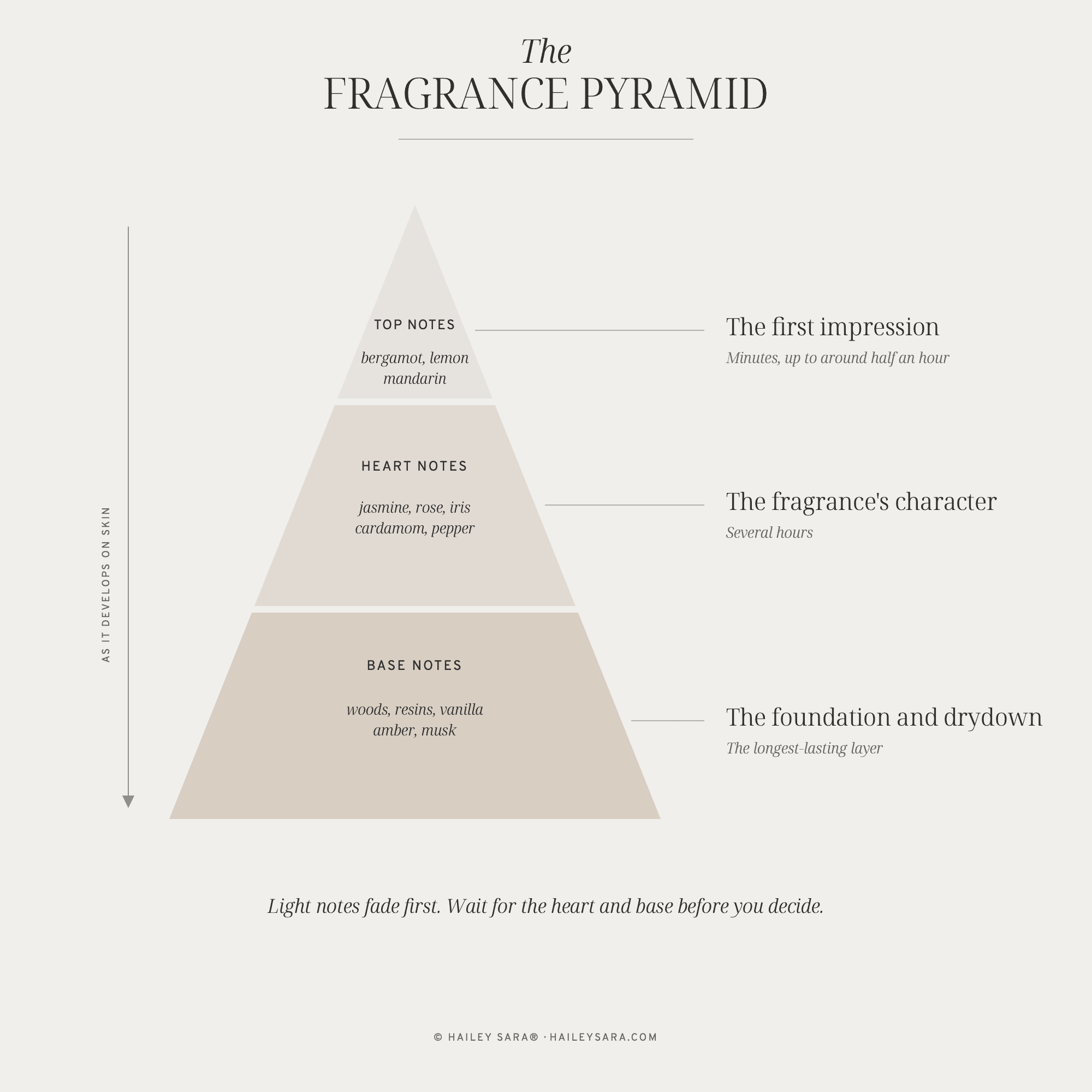
Perfumers describe a fragrance in three layers: top notes, heart notes and base notes. Together, they’re known as the fragrance pyramid, or the olfactory pyramid.
The layers exist because ingredients evaporate at different speeds. Small, light molecules evaporate quickly, so you smell them first and they fade first. Larger, heavier molecules evaporate slowly, so they stay on your skin the longest.
Top notes
Top notes are what you smell the moment you spray. They’re usually built from light, fast-evaporating ingredients like citrus, light herbs and some fruits. Bergamot, lemon, grapefruit and mandarin are classic top notes. They’re also the first to go, fading within minutes, or up to around half an hour.
When I worked with fragrance at Mecca and Sephora, I often saw people judge a scent on that very first impression. They’d spray, smell, and decide straight away, before the fragrance had any time to settle. Because the top notes are what you smell at the counter, they’re often designed to make a good first impression. But they’re only the beginning, and the heart and base are what you’ll be wearing for most of the day.
Heart notes
As the top notes fade, the heart notes come through. This is where the fragrance’s real character comes through, and what you’ll smell for most of the day.
Florals and spices often sit here, like jasmine, rose, iris, cardamom and pepper. Heart notes last for several hours.
Base notes
Base notes are the foundation. They appear last and stay longest, sometimes lingering on skin for many hours and on clothes for even longer.
This is where you’ll find the richest ingredients: woods, resins, vanilla, amber and musk. Base notes also help to hold the lighter notes in place, so the whole fragrance lasts longer. The final stage, when mostly the base notes are left, is called the drydown.
The pyramid in action
Maison Margiela Replica Jazz Club shows how much a fragrance can change over a day.
It opens with pink pepper, lemon and neroli, which feel fresh and a little spicy. As those fade, the heart brings in rum, clary sage and vetiver, and the scent becomes warmer. Finally, the base of tobacco leaf, vanilla and styrax settles in, and it becomes soft, smoky and sweet. By the drydown, it’s a very different scent from the first spray.
I noticed the same thing with Sunset Hour by Goldfield & Banks. The first spray is bright and fruity, with peach, mandarin and raspberry. As it settles, the caramel, vanilla and sandalwood come through, and it starts to feel less like fruit and more like skin after a day in the sun.
When the pyramid doesn’t apply
Not every fragrance follows the pyramid neatly. Some are built to smell much the same from the first spray to the drydown. These are often called linear fragrances.
Le Labo Santal 33 is often described this way. Rather than changing dramatically over the day, it stays close to its creamy sandalwood character throughout. If you love a scent at first spray and want it to stay that way, a linear fragrance is worth looking for.
What changes the timing
The timings above are a rough guide, because a few things can speed the pyramid up or slow it down. Concentration matters: an eau de parfum contains more fragrance oil than an eau de toilette, so each stage usually lasts longer. Your skin matters too. Warmth and dryness can change how quickly a fragrance evaporates, which is one reason the same scent can behave differently on different people.
Reading fragrance notes
Most brands list a fragrance’s notes on the box or their website, often split into top, heart and base. It’s a useful guide when choosing a scent, with one thing to keep in mind.
Not every note is a literal ingredient. Some are accords, blends of ingredients that together create the impression of one smell. Maison Margiela Lazy Sunday Morning, for example, lists a “lily of the valley accord”. Lily of the valley can’t be turned into a natural oil, so perfumers recreate its scent by blending other ingredients. A “sea salt” note works the same way. It’s a blend designed to smell like the sea, rather than actual salt.
So read a notes list as a description of how a fragrance smells, rather than a list of what’s inside it.
How to use this when you shop
- Don’t judge on the first spray. What you smell straight away is mostly top notes, and they’ll be gone soon. Give it at least 20 to 30 minutes before deciding.
- Spray it on your skin and see how it wears. A fragrance card is useful for a first impression, but it doesn’t have the warmth or natural oils of your skin, so it can smell quite different on you. Spray one or two favourites on your wrists and walk away.
- Wear it for a few hours before you buy. The heart and base are what you’ll live with, so make sure you love those, not just the opening.
- Look at the base notes. If you love vanilla and woods, a fragrance with those in the base is likely to suit you, whatever the top notes are.
Next, I’ll explain fragrance concentrations, and why an eau de parfum lasts longer than an eau de toilette.
The short edit
The essentials: Every fragrance has top, heart and base notes, which evaporate at different speeds. That’s why a scent changes over the hours you wear it.
Ask yourself: Do you love the fragrance, or just the first spray? Wait for the heart and base notes before you decide.
Worth knowing: A notes list describes how a fragrance smells, not exactly what’s inside it. Many notes are accords, blends created to smell like something that can’t be bottled naturally.