Have you ever loved a fragrance, bought something similar, and found you didn’t like it at all? Or tried something new and been surprised by how much it felt like you?
There’s usually a reason, and it comes down to fragrance families. Once you know which family you’re drawn to, choosing a new scent becomes much easier. You stop guessing, and you start knowing what to ask for.
The fragrance wheel
The fragrance industry groups scents using a tool called the fragrance wheel. The version most people use today was created by fragrance expert Michael Edwards, to help retailers and customers talk about scent in the same language.
The wheel has four main families: fresh, floral, amber and woody. Each one is split into smaller subfamilies, for 14 in total.
The clever part is the circle. Families that sit next to each other share some of the same character, so they blend into one another rather than stopping at hard lines. Think of it like a colour wheel. Orange sits between red and yellow, and in the same way, a floral amber sits between floral and amber.
Fresh
Fresh fragrances are bright, clean and energising. This family includes citrus notes like bergamot, lemon and grapefruit, green notes like cut grass and leaves, and water-like notes that remind you of the sea. Aromatic herbs like lavender and rosemary sit here too.
Who Is Elijah Ocean Eyes is a good example. It opens with grapefruit and mandarin, then moves into sea salt and juniper. It smells like a swim on a sunny morning.
Floral
Floral is the biggest family, and it covers everything from a single flower to a full bouquet. Some florals are fresh cut and dewy. Others are soft and powdery, with notes like iris and musk. The richest florals lean towards amber, with notes like orange blossom and sweet spice.
This is where I’d place Maison Margiela Replica Lazy Sunday Morning, and it’s a useful example because so many people describe it as fresh. It’s built on lily of the valley, iris and white musks, and Margiela describes it as the scent of clean linen on a sunny morning. It feels fresh because of those clean musks and airy flowers. Technically, though, it’s a floral.
That’s worth knowing when you shop. “Fresh” as a feeling and fresh as a family aren’t always the same thing. If you love scents that smell clean, you might find your favourites are soft florals or musks, rather than citrus.
Amber
Amber fragrances are warm, rich and enveloping. Think vanilla, resins, incense and warm spices like cinnamon and clove. You’ll often see this family called “oriental” in older guides and on some shop sites. Edwards renamed it amber in recent years, and it’s the term most of the industry now uses.
Kayali Vanilla 28 sits here. It blends vanilla orchid and jasmine with brown sugar and tonka bean, over amber, musk and patchouli. It’s soft and sweet, and it feels like a cashmere jumper in scent form.
Gourmand fragrances also live close to this family. These are the sweet, edible scents, with notes like caramel, vanilla and praline. Sunset Hour by Goldfield & Banks is one of my favourites, a sunny, fruity take on the style.
Woody
Woody fragrances are grounded and warm, built on notes like sandalwood, cedar, vetiver and patchouli. Some are smooth and creamy, others are dry and smoky, with hints of leather.
Le Labo Santal 33 is one of the best-known examples. It’s built around sandalwood, with cedar, cardamom, iris and a hint of leather. Creamy, dry and a little smoky, it’s the scent many people picture when they think of a modern woody fragrance.
Where families meet
Most fragrances don’t sit neatly in one family. They live on the edges, where two families overlap, and this is where the wheel becomes really useful.
Prada Paradoxe is a good example. It’s a floral, with bright neroli, but it sits on a warm base of amber and musk. That places it right where floral meets amber.
Maison Francis Kurkdjian Baccarat Rouge 540 goes even further. The brand describes it as a woody ambery floral, so it touches three families at once. Jasmine and saffron sit over ambergris and cedar, which gives it that glowing, sweet-woody trail so many people recognise.
This is why you can love two fragrances that seem very different at first. They often share a neighbour.
How to find your family
- Look at the fragrances you already love. Write down two or three favourites and look up their notes on the brand’s website. You’ll usually spot a pattern, like lots of vanilla, lots of citrus or lots of white flowers.
- Explore next door. Once you know your family, try scents from the family beside it on the wheel. If you love florals, try a floral amber. If you love fresh citrus, try a woody scent with a bright opening.
- Ask by family at the counter. Instead of “I want something nice”, try “I usually wear warm amber scents, but I’d like something lighter for summer”. A good consultant will know exactly where to take you.
- Don’t rely on labels alone. Brands describe families in their own words. One might call a scent “warm and spicy”, another “fresh and floral”. Look at the notes, not just the label.
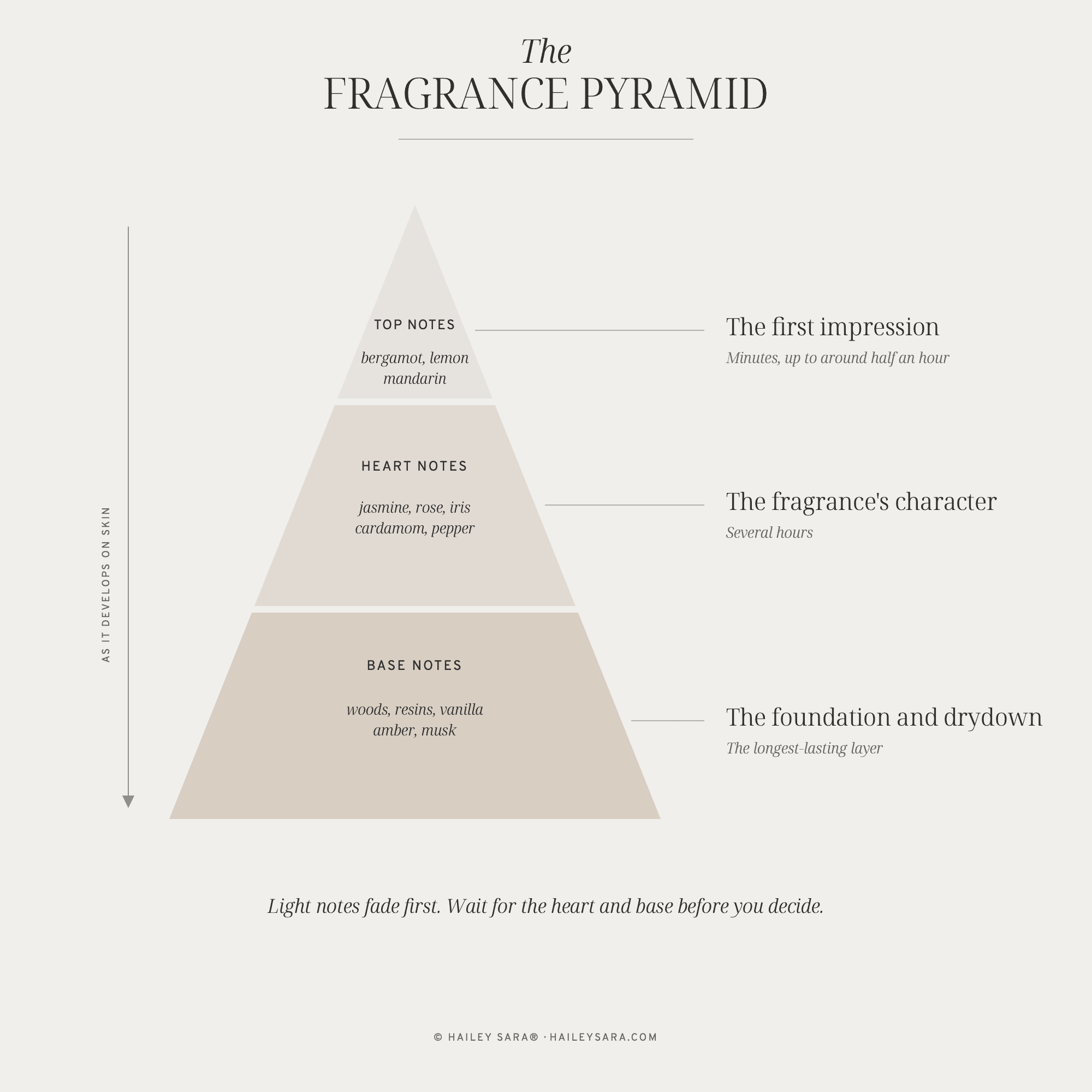
Knowing your family is the first step. Next, I’ll explain the fragrance pyramid, and why a scent can smell completely different an hour after you spray it.
The short edit
The essentials: The fragrance wheel groups scents into four families, fresh, floral, amber and woody, and neighbouring families share some of the same character.
Ask yourself: What do your favourite fragrances have in common? Look at the notes, and you’ll probably find your family.
Worth knowing: “Fresh” as a feeling isn’t always fresh as a family. Many clean-smelling scents are actually soft florals or musks.