Powder is one of those steps people either can’t live without, or avoid completely.
Some people wouldn’t leave the house without it. Others skipped it years ago after one too many dry, cakey days, and never went back. And most people are somewhere in between, using whatever powder they happen to own, without being quite sure what it’s meant to be doing.
Like every other step, the answer comes back to purpose. Once you know what you need a powder to do, choosing one, and deciding whether you need one at all, becomes much simpler.
What powder actually does
Powder does one or more of three things:
- It sets. Liquid and cream products stay in place, so they don’t crease, move or transfer.
- It absorbs. Powder soaks up oil through the day, keeping shine under control.
- It adds coverage. Some powders are tinted, and add a little extra coverage on top of, or instead of, foundation.
Different powders do different jobs, and different skin types need different things from them. That’s where most people go wrong.
Do you need one?
Not always.
If your skin is dry, you love a dewy finish, or your foundation sets well on its own, you may not need powder at all, or only the lightest touch.
Powder earns its place if your skin is oily, if your foundation creases or slides through the day, or if you need your makeup to last through a long day or a special occasion.
So the question isn’t “should I use powder?” It’s: what do I need it to do, and where?
Powder for your skin type
- Oily skin benefits most. A loose powder does two jobs here: it sets your foundation, and it keeps absorbing oil throughout the day, so you stay matte for longer.
- Dry skin needs much less. A light dusting to set, usually with a finely milled pressed powder, is often enough. Too much powder on dry skin can sit on dry patches, emphasise texture and make skin look flat or cakey.
- Combination skin does best with a strategic approach. A light set all over, then a little more powder only where you get oily, usually the nose, forehead and chin.
- Balanced skin can choose based on the finish it wants: a light set for a natural look, or more for longer wear.
Where you place it matters as much as which one you use. Powder doesn’t have to go everywhere. Most people only need it in the centre of the face, around the nose, and anywhere that tends to crease, like under the eyes.
Powder and your foundation
Your foundation matters too, because some foundations set on their own, and others never really set at all.
Self-setting foundations, often long-wear or matte formulas, dry down on the skin once they’re applied. They stay put, so they may need very little powder, or none at all, especially on dry or balanced skin.
Dewy, cream and oil-based foundations don’t fully set on their own. They stay soft and radiant, which is lovely, but it also means they can move, crease or transfer through the day. These are the foundations that benefit most from a light layer of powder, placed where you need it most.
If you have dry skin and wear an oil-based foundation, you’ll want a balance: enough powder to set it where it tends to move, like around the nose and under the eyes, but light enough that it doesn’t undo the hydration the foundation gives you.
The different types
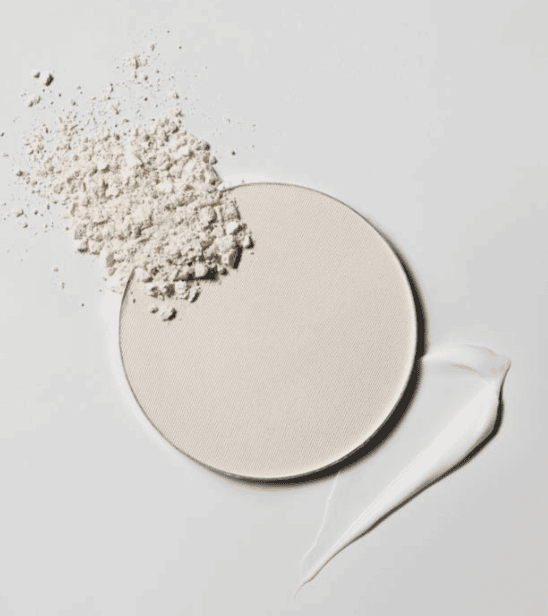
- Loose powder is finely milled and very versatile. It’s the most effective for setting and absorbing oil, which is why it’s so popular for oily skin. It usually gives a sheer finish.
- Pressed powder comes in a compact, which makes it ideal for touch-ups on the go. It often gives slightly more coverage than loose powder, and suits dry and balanced skin when used lightly.
- Powder foundation gives coverage, either on its own or over a liquid foundation. It suits oily skin particularly well.
- Translucent powder has no colour, or very little, so it sets without changing your foundation shade. It’s the most common type of setting powder.
- Tinted powder has colour, adding a little coverage and warmth as it sets.
- Baked powder goes through a baking process, which gives it a softer, more luminous finish. It tends to suit dry and mature skin better than a traditional matte powder.
A note on flashback
You’ve probably seen the red carpet photos: a celebrity with a ghostly white cast under their eyes or across their face, captured by the camera flash. It’s every makeup artist’s nightmare.
That’s flashback, and it happens when certain ingredients reflect the light from a camera flash. The most common culprits are silica, found in many translucent and “HD” powders, and the mineral sunscreen ingredients titanium dioxide and zinc oxide. They can look invisible to the eye, and completely white in a photo.
If you’re wearing makeup for an event where photos will be taken with flash, a few things help:
Use less powder, and blend it well.
Choose a tinted powder over a heavy white translucent one.
Take a test photo with flash before you leave the house. If there’s a white cast, you’ll see it straight away.
How to apply it
- For a light set, use a large, fluffy brush and tap off the excess before you apply.
- For more oil control, press the powder into your skin with a powder puff or a damp sponge, rather than sweeping it on. It sits closer to the skin and lasts longer.
- Start with less. You can always add more, but too much powder is hard to take away.
- Target where you need it, rather than covering your whole face by default.
You may also have heard of baking, a technique where you leave powder on the skin for a few minutes to set before dusting it away. It’s popular for long-lasting, crease-free makeup, but it isn’t right for every skin type. It deserves a post of its own.
To powder or not to powder
The answer, as with most things, depends on your skin, your foundation, and what you want your makeup to do.
If you’re oily, powder is likely one of your most useful steps. Dry skin may need only a little, in the right places. And when your foundation sets on its own, you may barely need it at all. Somewhere in between? A light set and a little strategy can go a long way.
Choose the powder for its purpose, place it where you need it, and use less than you think.
Find your match
Loose translucent powder
Best for oily and combination skin. Sets foundation and absorbs oil through the day, without adding colour. Use lightly for photos.
Pressed powder
Ideal for touch-ups, and for dry or balanced skin that needs only a light set. Often adds a touch of coverage.
Tinted setting powder
A good choice if you want a little extra coverage and warmth as you set, and for flash photography.
Powder foundation
Suits oily skin that wants coverage and oil control in one step.
Baked powder
Best for dry and mature skin, and for a softer, more luminous finish than a traditional matte powder.
The short edit
The essentials:
Powder sets, absorbs or adds coverage. Choose it for what you need it to do, your skin type and your foundation, and place it only where you need it.
Ask yourself:
Am I using powder all over out of habit, when I only really need it in my T-zone?
Worth knowing:
Flashback, the white cast in flash photos, is usually caused by silica or mineral sunscreen ingredients. Take a test photo with flash before a big event.